Minecraft is full of choices that seem simple at first but reveal complexity as you play more. One of those choices is deciding between charcoal and coal. Both are black resources that fuel your furnaces and torches. They look almost the same and do similar things. But are they really equal? Which one is better for survival, building, and automation? Understanding the real differences between Minecraft charcoal vs coal can change how you play, especially if you want to optimize your resources or become more efficient.
Let’s dig deep into every aspect of charcoal and coal in Minecraft. We’ll look at their crafting, uses, how you get them, how they work with redstone, and much more. By the end, you’ll know exactly which resource to use, when, and why.
What Are Charcoal And Coal In Minecraft?
Both charcoal and coal are items you use as fuel in Minecraft. They are also used to craft torches. But they have different origins and special uses.
Coal is a mineral you find in the world. You mine it from coal ore blocks, often in caves or on the side of mountains. You can spot coal ore easily, because the blocks have black specks. Charcoal is not found naturally. Instead, you make it by smelting wood logs in a furnace.
At first glance, they look almost the same. Their icons are similar, and their names are just one letter apart. But their differences matter, especially as your world grows. For example, you may notice that some recipes only accept coal, not charcoal, and some villagers only want coal.
These little details can be important as you build more advanced setups.
How To Obtain Coal And Charcoal
Mining Coal
You find coal ore blocks in most biomes, usually below sea level and up to Y=320. When you break coal ore with any pickaxe, it drops coal. This is a fast way to get fuel early in the game.
- Best tools: Any pickaxe (even wooden)
- Drop rate: 1 coal per block (more with Fortune enchantment)
- Experience: Breaking coal ore also gives experience orbs
Large coal veins can contain up to 17 blocks. This makes coal one of the easiest minerals to gather, especially in the early game. If you use a Fortune III pickaxe, you can get up to four coal per block, which quickly adds up and helps you store more fuel with less mining effort.
Coal ore is often visible on the surface of mountains, especially in high-altitude biomes. This makes it possible to collect a lot of coal without deep mining, which can be helpful before you have good armor or weapons. Also, if you use Silk Touch, you can collect the ore itself for decoration or later mining.
Crafting Charcoal
Charcoal is not mined. You create it by smelting any wood log in a furnace, smoker, or blast furnace.
- Recipe: 1 wood log + 1 fuel (any) → 1 charcoal
- Works with: Oak, birch, spruce, jungle, acacia, mangrove, cherry, dark oak logs
You do not need a pickaxe. You just need access to trees and a furnace. This makes charcoal possible even before you find any coal ore. If you spawn on an island, in a forest, or even in a desert near a river with a few trees, you can start making charcoal right away.
A smart trick is to use your first charcoal to smelt more logs, creating a loop where you never run out of fuel. This is called “bootstrapping” your fuel supply. It’s especially useful in custom maps or in the early game when resources are limited.
Which Is Easier To Get?
- Early game: Charcoal is easier if you spawn far from caves but near trees.
- Late game: Coal is easier if you have a good pickaxe and go mining.
If you play in a superflat world or in a biome without easy access to stone, charcoal lets you progress without mining. In some cases, players set up small tree farms right at the start to have a renewable source of fuel and building materials.
Another detail: when you clear forests, you often get apples and saplings as bonus drops, making tree farming for charcoal even more useful. Saplings let you replant, and apples are a good early food source.

Credit: www.reddit.com
Fuel Efficiency And Smelting Power
Both charcoal and coal are used as fuel. But do they work the same?
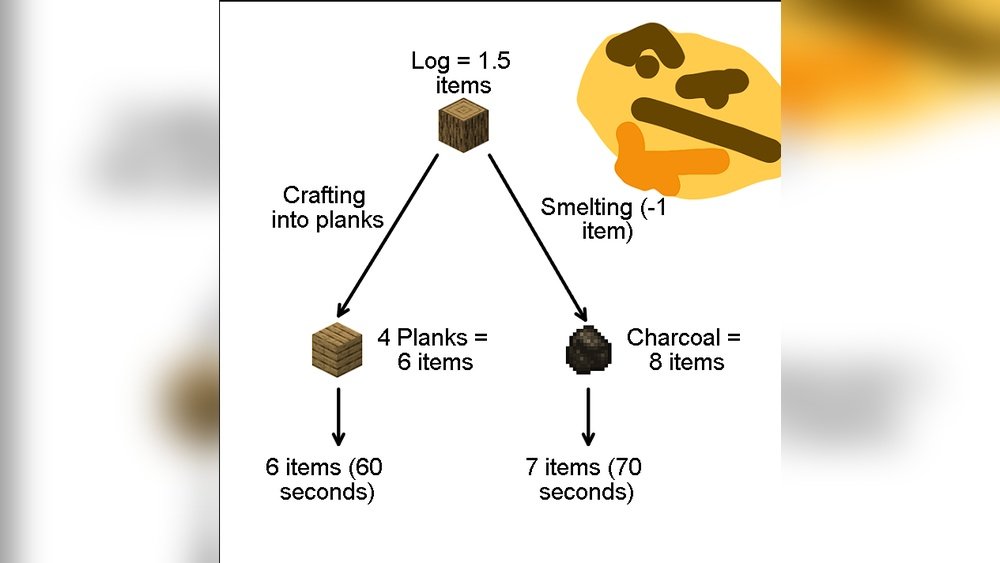
- Burn time: Both burn for 80 seconds (8 items)
- Efficiency: Identical—each smelts 8 items in a furnace, smoker, or blast furnace
Here’s a comparison table for quick reference:
| Fuel Type | Burn Time (Seconds) | Items Smelted |
|---|---|---|
| Coal | 80 | 8 |
| Charcoal | 80 | 8 |
| Wood Log | 15 | 1.5 |
| Stick | 5 | 0.5 |
Coal blocks are special: you can craft 9 coal into a coal block, which smelts 80 items. Charcoal cannot be crafted into blocks, so coal can be more efficient for large smelting projects.
A practical tip: If you are running a big auto-smelter, using coal blocks means you refill fuel less often, and your hoppers and chests last longer before needing attention. Charcoal requires more frequent refills and more chest space, which can become a real challenge with huge farms.
Another thing to remember: some fuels, like blaze rods, burn longer (smelt 12 items), but are harder to get. For most survival players, coal and charcoal are still the best balance between effort and output.
Crafting: Torches And More
Most players use coal or charcoal to craft torches. The recipe is simple:
- 1 stick + 1 coal = 4 torches
- 1 stick + 1 charcoal = 4 torches
You can use either resource, and the torches work exactly the same. No difference in light level, duration, or behavior.
Advanced crafting:
- Coal is used to craft blocks of coal (for storage or decoration).
- Charcoal cannot be crafted into blocks or used for fire charges.
Here’s a summary:
| Item | Crafts Torches? | Crafts Blocks? | Fire Charge Recipe? |
|---|---|---|---|
| Coal | Yes | Yes | Yes |
| Charcoal | Yes | No | No |
Coal is also used for making fire charges (with blaze powder and gunpowder). Fire charges act as single-use flint-and-steel and can light nether portals, set blocks on fire, or be loaded into dispensers. Charcoal cannot be used in this recipe, which sometimes surprises new players.
If you want to store large amounts of torch supplies, either resource works, but for block storage or advanced crafting, coal has the edge.
Storage And Stackability
Both coal and charcoal stack to 64 in your inventory. But coal can be crafted into a block, which saves space:
- Block of coal: 9 coal → 1 block (stacks to 64, stores 576 coal)
- Charcoal: No block form, only stacks to 64
For big mining or smelting operations, blocks of coal make inventory management much easier. If you use only charcoal, you will need more chests and more slots.
This matters a lot in late-game bases where you might want to store thousands of fuel items for auto-smelters, XP farms, or backup supplies. Blocks of coal take much less space and are easier to transport, especially if you want to move your fuel around using shulker boxes.
If your base is in the sky or spread across different areas, carrying blocks of coal is less hassle. On the other hand, if you only use charcoal, you may need to design your storage rooms larger or automate the supply more carefully.
Renewable Vs Non-renewable Resources
One of the most important differences is how you get each resource over the long term.
Charcoal: 100% Renewable
Charcoal is made from logs, which come from trees. Trees grow from saplings, which you can plant and regrow forever. This makes charcoal a truly infinite resource.
If you want a world that can run forever without running out of fuel, charcoal is the best choice. Many advanced players build tree farms connected to auto-smelters for endless charcoal.
There are many ways to automate tree farming, from manual planting and harvesting to full redstone and piston farms that chop trees for you. With bone meal, you can speed up growth and keep your fuel supply always full. This is especially useful in multiplayer servers where resources can run out.
Coal: Finite In Most Worlds
Coal comes from coal ore, which is limited. Once you mine all the coal in your world, it does not regrow. In normal survival, coal will eventually run out, especially if you play for hundreds of hours.
The only renewable way to get coal is by:
- Trading with villagers (specifically, armorer, toolsmith, and weaponsmith)
- Killing Wither Skeletons (rare drop)
But these methods are slow and not practical for large-scale fuel.
In some worlds, especially old or very active ones, coal ore becomes rare. Players often regret using coal for early torches or fuel and wish they had saved it for trading or block crafting. Planning ahead can save you this frustration.

Credit: www.reddit.com
Trading With Villagers
If you enjoy trading, here’s a key insight: coal can be traded with villagers, but charcoal cannot.
- Armorer, toolsmith, weaponsmith villagers: Buy coal for emeralds (15-24 coal for 1 emerald)
- No villager buys charcoal
You cannot use charcoal to trade for emeralds. If you want to earn emeralds using fuel, you must collect coal.
This makes coal valuable even in the late game, when you might have automated everything else. Players often mine coal just to trade for emeralds and then use those emeralds to buy enchanted gear or rare items.
Be careful not to use up all your coal, or you may miss out on these profitable trades. Save some for future trading, especially if you want to level up toolsmiths or armorers quickly.
Automation And Redstone
Many players build auto-smelters powered by hoppers and redstone. The choice between coal and charcoal affects how you automate your world.
Charcoal Farms
- Fully automatic: Use tree farms, auto-log harvesters, and furnaces
- 100% renewable with no mining
- Easy to scale for big projects
You can even design a system where logs go directly from a farm into a furnace, and the charcoal produced is used to make more charcoal, with the extra going to your storage or smelter. This means you never need to mine for fuel again.
Coal Mining
- Not automatic (unless you use TNT duping or complex machines)
- Requires player mining trips
- Limited by world generation
If you want to automate your smelting completely, charcoal is the best choice.
Non-obvious insight: Because charcoal cannot be crafted into blocks, auto-smelters that need to store fuel for long periods require more chest space. This can make logistics a little harder compared to block-of-coal systems.
Also, if your smelter uses minecarts with chests, using only charcoal may mean refilling more often, especially for large builds or multiplayer servers.
Building With Coal And Charcoal
Players sometimes use coal blocks for decoration, building, or pixel art. Charcoal has no block form, so you cannot build with it.
Coal blocks are:
- Deep black, good for contrast in builds
- Used in some Minecraft art projects
- Burn as fuel (smelts 80 items per block)
If you want a black block for building, coal is your only choice. Charcoal is not suitable for decoration.
Some creative players use coal blocks to make outlines in pixel art or to add detail to modern builds. The strong black color does not fade or change in different light, making it reliable for design.
If you want to keep your builds renewable or eco-friendly, you might choose black wool, blackstone, or concrete instead—but coal blocks are the classic look and still the only fuel block among the black blocks.
Experience Farming
When you smelt items in a furnace, you get experience points. Both coal and charcoal give the same result for smelting.
But if you want to maximize experience farming, charcoal is better, because you can automate it. Plant, grow, and harvest trees, smelt the logs, and collect the XP. No need to mine coal ore.
Many players set up XP farms that use bamboo and kelp as fuel, but charcoal is often simpler and needs less setup. You can collect thousands of XP by smelting cactus, potatoes, or clay, all powered by infinite charcoal.
One thing beginners miss: XP is only stored in the furnace until you take out the smelted item. If you smelt 1000 items, all that XP waits for you in the furnace—so you can collect it in one big burst!
When To Use Each: Practical Scenarios
Early Game Survival
If you spawn in a forest or near lots of trees, make charcoal. If you spawn in a mountain or cave-heavy area, mine coal. Both are good for torches, but charcoal is faster if you have no pickaxe yet.
A common example: You chop your first tree, make a wooden pickaxe, get stone, build a furnace, then smelt logs into charcoal. In less than 10 minutes, you can have torches and cooked food without ever going underground. This helps you survive the first night and avoids early dangers.
Mid To Late Game
- Charcoal: Best for big auto-smelters, renewable worlds, or if you want to stop mining for fuel.
- Coal: Best if you want to trade with villagers, build with coal blocks, or need to store fuel compactly.
When your base grows and you need to smelt thousands of iron, glass, or food, charcoal becomes your main workhorse. Coal is kept for special uses, like trading or decoration.
Hardcore Worlds
In hardcore mode, where you cannot respawn, many players prefer charcoal. This avoids dangerous cave mining and lets you get fuel above ground.
Charcoal allows you to play safely, focusing on base building and farming instead of risky mining. It’s a smart strategy for long survival runs.
Skyblock And Custom Maps
Most custom maps give you trees but no coal ore. Charcoal is the only way to get fuel and torches.
Skyblock challenges often require you to automate tree farming for charcoal to progress. This is a great way to learn about renewable systems and automation early.
Multiplayer Servers
On busy servers, coal ore disappears quickly as players mine the world. Charcoal farming ensures every player can have fuel, even if the mines are empty. This is why many server admins encourage tree planting and set up public tree farms.
Common Mistakes And How To Avoid Them
- Mixing Coal and Charcoal in Crafting: You cannot mix coal and charcoal to craft blocks of coal. This wastes space if you try.
- Wasting Wood: Smelting planks or sticks is less efficient than smelting logs into charcoal. Always use logs.
- Mining All Coal Early: Saving coal for trading or block crafting is smart. Use charcoal for fuel instead.
- Ignoring Renewable Fuel: Players often overlook tree farms. Planting saplings gives you infinite fuel with little effort.
- Not Using Silk Touch: Mining coal ore with Silk Touch gives you the block. This is only useful if you want to decorate with coal ore; otherwise, use Fortune to get more coal.
A less obvious mistake: Storing only charcoal in auto-smelter systems without enough chest space. Over time, your fuel storage fills up too fast. Plan your chests and hoppers with this in mind, or use coal blocks when possible.
Environmental Impact (in-game Logic)
While Minecraft does not simulate pollution, you might enjoy role-playing as an eco-friendly player. Charcoal is considered “renewable,” like real-life wood-based fuels, while coal is “non-renewable,” like fossil fuels.
Some players build worlds where they only use renewable resources. This gives an extra challenge and can be more fun in the long run.
You can even challenge yourself to replant every tree you cut down and only use charcoal for fuel. This adds another layer of strategy to your builds and resource management.
Charcoal Vs Coal: Data Table
Here is a side-by-side comparison for every important factor:
| Feature | Coal | Charcoal |
|---|---|---|
| Obtained By | Mining coal ore | Smelting wood logs |
| Renewable? | Mostly no | Yes |
| Burn Time | 80 seconds | 80 seconds |
| Crafts Torches | Yes | Yes |
| Crafts Blocks | Yes | No |
| Villager Trades | Yes | No |
| Decoration Use | Yes (block form) | No |
| Stack Size | 64 (block stacks to 64) | 64 |
Real-life Inspiration
Minecraft’s charcoal and coal are inspired by real materials. In the real world, charcoal is made from heating wood without oxygen, and coal comes from ancient plant matter compressed over millions of years. The game keeps things simple, but the ideas are based on real science.
If you want to learn more about how charcoal and coal are used outside Minecraft, you can check the Wikipedia page on Charcoal.
Two Non-obvious Insights
- Charcoal for Infinite Worlds: If you plan to play a world for a long time, especially with big builds or farms, switching to charcoal early saves you from running out of fuel. Most beginners use coal and only switch when coal veins get rare.
- Storage Efficiency: If you run a massive auto-smelter, using coal blocks is much easier for storage and refilling. But if you only use charcoal, you must design your storage to handle single stacks. This small detail matters in redstone builds.
Another advanced tip: If you use a sorting system, keep in mind that coal and charcoal look similar but do not stack together. Misplacing them in the wrong chest can break your automation and waste time.

Credit: www.youtube.com
Advanced Tips For Expert Players
- Beacon Fuel: Neither coal nor charcoal can be used to power beacons—only iron, gold, emerald, netherite, or diamond blocks work.
- Wither Skeletons: Wither skeletons drop coal, not charcoal. This is one way to get coal in the Nether or late-game.
- Sorting Systems: Charcoal and coal cannot stack together. This can break sorting systems if you are not careful.
- Super Smelter Design: If you build a super smelter for XP, use charcoal for infinite fuel. If you want to store fuel compactly, design it around coal blocks.
For large multiplayer worlds, consider making a central fuel hub with both types: one storage room for blocks of coal, another for charcoal, and clear signs to prevent mix-ups.
Which Should You Use?
If you want an easy answer:
- Use charcoal for all your fuel needs, especially if you have lots of wood.
- Use coal if you want to trade, build with coal blocks, or store fuel efficiently.
But the best players use both. They keep coal for special uses and automate charcoal for daily fuel.
A pro move: In the early game, use charcoal to save coal for later. In the late game, use coal blocks for bulk storage and trading, but power your farms and smelters with infinite charcoal.
Frequently Asked Questions
What Burns Longer, Charcoal Or Coal In Minecraft?
Both charcoal and coal burn for the same amount of time in furnaces—80 seconds each, which equals smelting 8 items. There is no difference in burn time.
Can You Craft Blocks Of Charcoal?
No, you cannot craft blocks of charcoal in Minecraft. Only coal can be crafted into blocks. Charcoal only stacks up to 64 and cannot be compacted.
Is Charcoal Better Than Coal In Minecraft?
Charcoal is better for renewable fuel and automation. Coal is better for trading, building blocks, and compact storage. Neither is always “better”—it depends on your playstyle and needs.
Can Villagers Trade Charcoal?
No, villagers do not buy charcoal. Only coal can be traded with armorer, toolsmith, and weaponsmith villagers for emeralds.
How Do You Get Charcoal If You Don’t Have Coal?
Smelt any type of wood log in a furnace. The furnace needs any fuel (planks, sticks, etc.). After the first charcoal, you can use that charcoal as fuel to make more. This is called a charcoal chain, and it allows you to multiply your fuel without ever mining coal.
Minecraft offers many ways to play. Knowing when to use charcoal and when to use coal will help you survive, build, and automate better. Whether you’re a new player or a veteran, mastering this simple choice can make your world more efficient and fun.