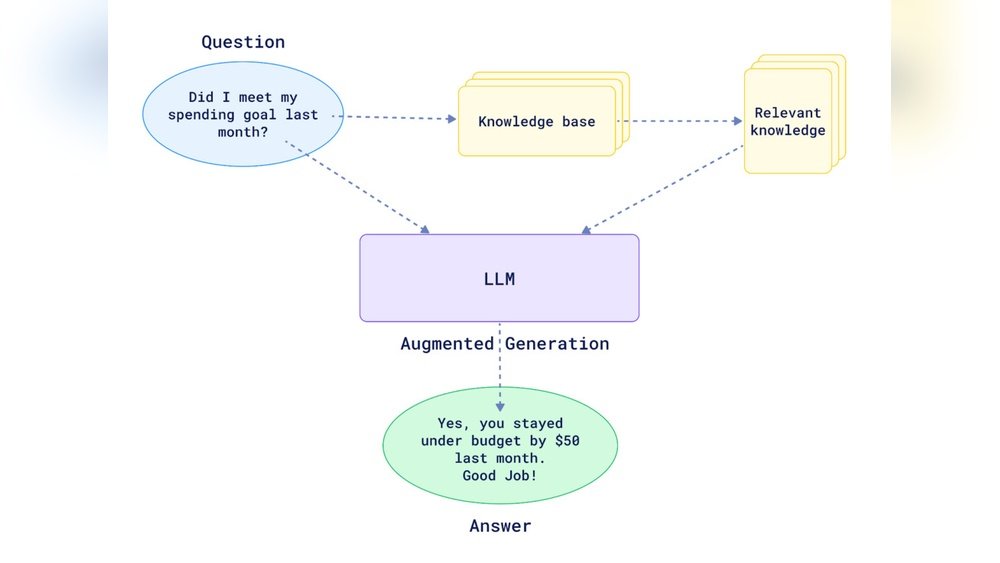
If you’ve ever wondered how AI can give you more accurate and reliable answers, understanding RAG is key. RAG, or Retrieval-Augmented Generation, is a smart technique that boosts AI’s ability to find and use relevant information right when you need it.
Imagine having an assistant who quickly digs through tons of data to give you precise, up-to-date answers—RAG does exactly that for AI models. You’ll discover how RAG works, why it matters, and how it can transform the way AI serves your needs.
Keep reading to unlock the power behind this game-changing AI approach.
Rag Basics
Retrieval-Augmented Generation, or RAG, is a method in AI that improves answer quality.
This method helps AI find facts from outside sources before creating responses.
RAG connects a language model to a database or knowledge base. This setup helps the AI access fresh and accurate information it did not learn during training.
The result is smarter, more reliable answers that rely on real data instead of guesses.
What Does Rag Mean?
RAG stands for Retrieval-Augmented Generation. It combines two key AI steps.
First, it retrieves relevant documents or facts from a collection of data.
Next, it generates a response using the retrieved information as a guide.
This two-step process makes AI responses more precise and useful.
RAG starts by searching a knowledge source like documents or databases.
It finds the most relevant information related to the user’s question.
Then, the AI model uses this information to build a better answer.
This approach reduces errors and improves the trustworthiness of the AI’s output.
Why Use Rag In Ai?
RAG helps AI systems provide up-to-date and specific information.
It is useful when AI needs to handle detailed or niche topics.
RAG also lowers the chance of AI making things up or giving wrong facts.
This makes AI tools more helpful in real-world applications.
How Rag Works
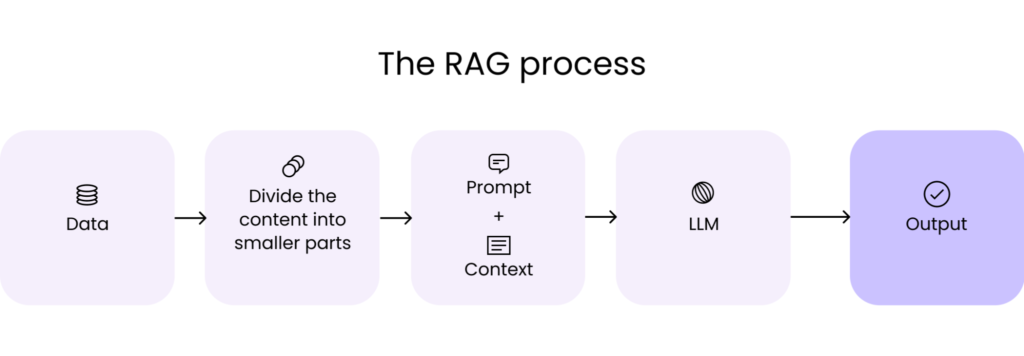
Retrieval-Augmented Generation (RAG) improves AI responses by combining two key steps. It first gathers relevant data, then uses that data to create clear answers. This method helps the AI provide accurate and reliable information. The process involves data ingestion, information retrieval, and response generation. Each step plays a vital role in how RAG works effectively.
Data Ingestion
Data ingestion means collecting and storing information from various sources. These sources can include documents, web pages, or databases. The AI system organizes this data to make it easy to search. Proper ingestion ensures the system has a wide range of facts and knowledge. This step builds the foundation for accurate retrieval later.
Information Retrieval
Information retrieval is the process of finding the most relevant data for a question. The AI searches the ingested data to locate useful documents or facts. It uses keywords or other signals to narrow down the search. This step ensures the AI focuses on important and related information. Good retrieval improves the quality of the final response.
Response Generation
Response generation combines the retrieved information with language models. The AI uses the relevant data to create clear and precise answers. It writes responses that are easy to understand and fact-based. This step reduces errors and “hallucinations” in AI replies. The final output is a helpful and trustworthy answer for users.
Key Benefits
Retrieval-Augmented Generation (RAG) offers several key benefits that improve AI performance. It combines retrieval of relevant data with generation, making AI smarter and more reliable. These benefits help AI provide precise and useful answers across many fields.
Improved Accuracy
RAG boosts AI accuracy by using real information from trusted sources. It reduces mistakes and guesses often made by AI models. This leads to clearer and more correct answers for users.
Access To Current Data
RAG connects AI to up-to-date databases and documents. It allows AI to use recent facts instead of outdated training data. This keeps AI responses fresh and relevant to today’s needs.
Domain Expertise
RAG lets AI tap into specialized knowledge bases. It helps AI understand specific industries or topics better. This focus improves the quality of answers in fields like law, medicine, or finance.
Scalability
RAG scales easily to handle large amounts of data. It supports AI growth without losing performance. This makes it suitable for businesses of all sizes and data volumes.
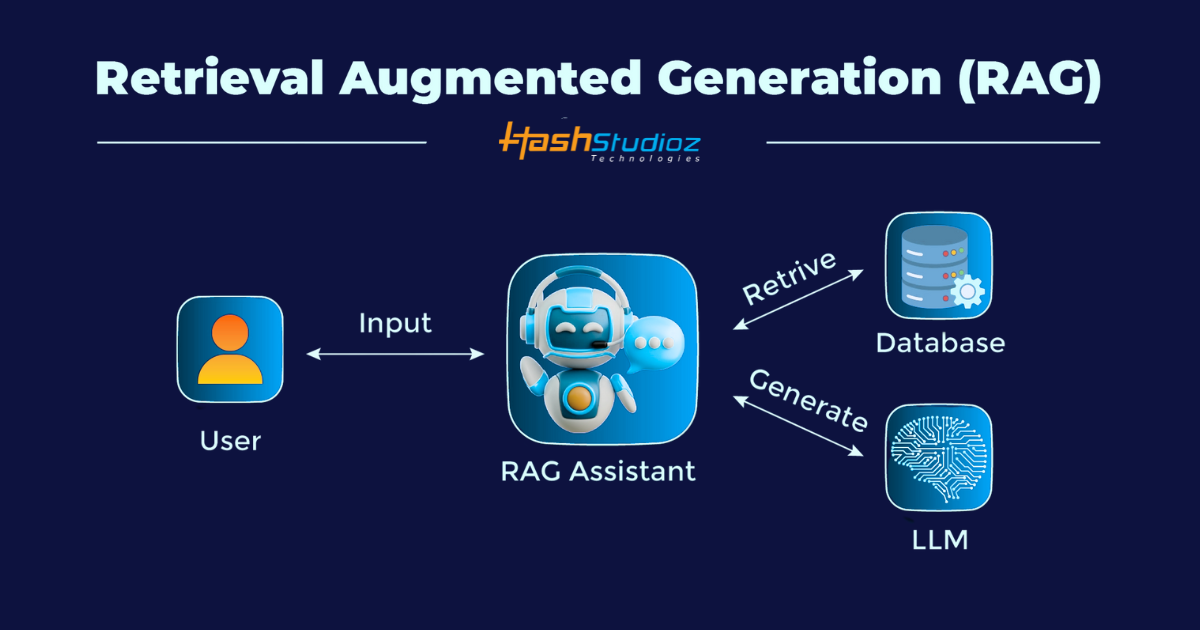
Credit: www.hashstudioz.com
Rag Vs Traditional Ai Models
Comparing RAG with traditional AI models reveals key differences in how they handle information. Traditional AI models rely mainly on the data they were trained on. They generate answers based on patterns learned during training. These models may lack access to up-to-date or specialized knowledge outside their training data.
RAG, or Retrieval-Augmented Generation, changes this approach. It retrieves relevant information from external sources before creating a response. This helps RAG models provide more accurate and context-aware answers. The combination of retrieval and generation makes RAG suitable for tasks needing current or detailed knowledge.
Data Access And Updating
Traditional AI models have fixed knowledge after training. They cannot learn new information unless retrained. RAG models connect to external databases or documents. This connection lets them access fresh and specific data anytime.
Answer Accuracy And Reliability
Traditional models sometimes produce incorrect or vague answers. Their knowledge is limited to training examples. RAG models use retrieved facts to support responses. This leads to more trustworthy and precise answers.
Flexibility And Use Cases
Traditional AI suits general tasks but struggles with niche topics. RAG adapts to many domains by using different data sources. It works well for complex questions needing detailed context.
Computational Efficiency
Traditional AI models generate answers in one step. RAG requires retrieval plus generation, which may take more time. Yet, this trade-off improves answer quality in many situations.
Applications Of Rag
Retrieval-Augmented Generation (RAG) has many useful applications across industries. It improves AI by combining knowledge retrieval with text generation. This makes AI responses more precise and trustworthy. RAG is shaping how businesses use AI to solve real problems. Below are key areas where RAG is making an impact.
Enterprise Solutions
Enterprises use RAG to handle large data sets efficiently. It helps in customer support by providing quick, relevant answers. RAG also aids in data analysis by summarizing complex reports. Businesses improve decision-making with faster access to accurate information. The technology supports internal knowledge bases, making employee training easier.
Legal Services
Law firms apply RAG to analyze vast legal documents quickly. It retrieves case laws, contracts, and regulations in seconds. Lawyers get precise information to build stronger cases. RAG reduces the time spent on research and review tasks. It also helps in drafting legal documents with updated data.
Manufacturing
Manufacturers use RAG to optimize production processes. It retrieves technical manuals and safety protocols on demand. RAG supports predictive maintenance by analyzing equipment data. This reduces downtime and lowers repair costs. It also improves quality control by accessing real-time reports and standards.
Building A Rag System
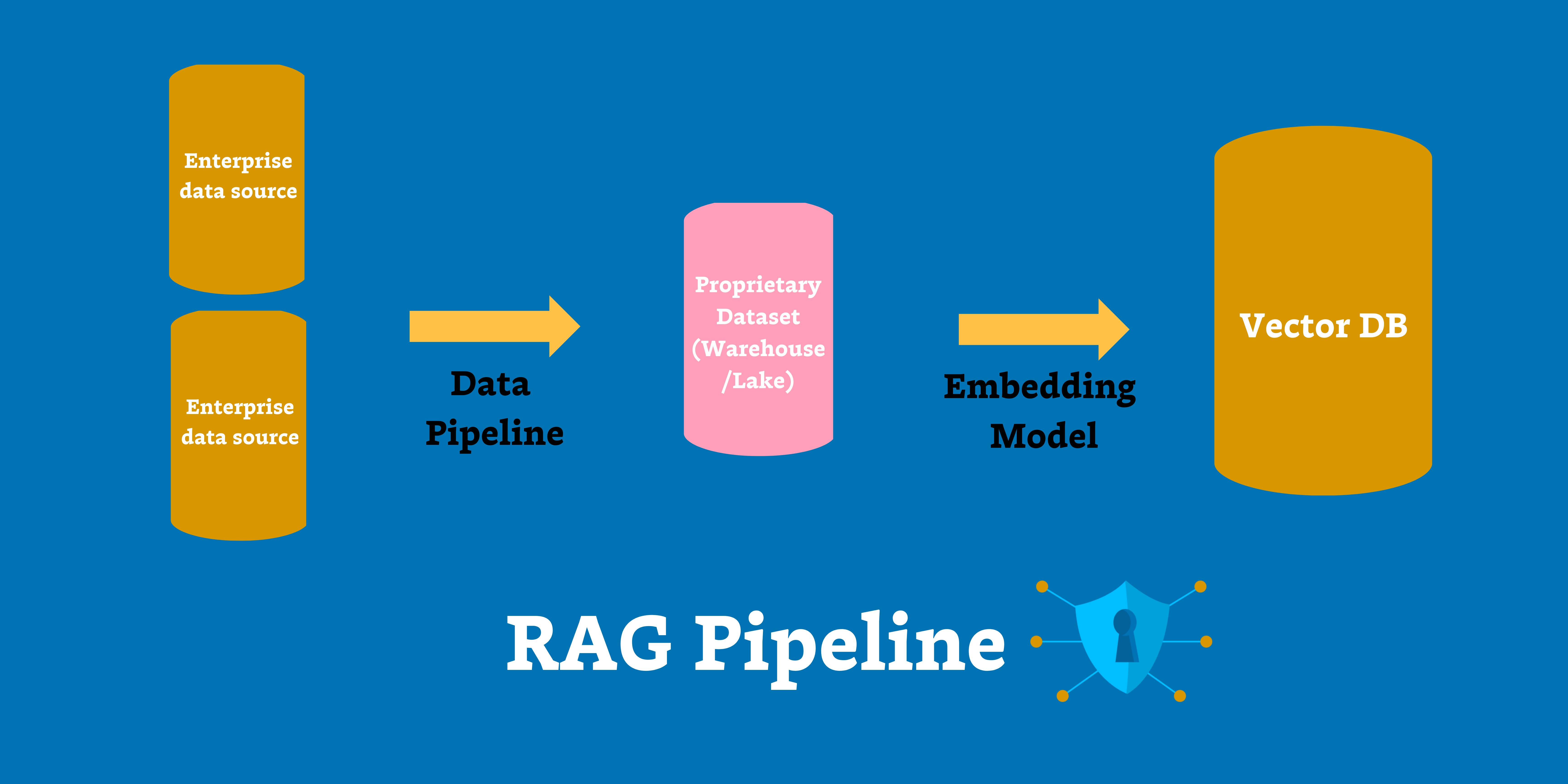
Building a RAG system involves combining retrieval techniques with generative AI models. This approach improves the quality of AI responses by providing relevant information from external knowledge bases. It helps the AI produce accurate and context-aware answers. The process includes selecting proper knowledge sources, creating embeddings, and integrating generative models. Each step is essential to build an effective RAG system.
Selecting Knowledge Sources
Choosing the right knowledge sources is the first step. These sources can be databases, documents, websites, or any structured or unstructured data. The data should be relevant and updated to ensure accurate retrieval. Quality and diversity in sources improve the AI’s ability to answer various questions. Avoid outdated or irrelevant information to maintain system reliability.
Creating Embeddings
Embeddings convert text data into numerical vectors that machines understand. This transformation allows the system to find similar or relevant information efficiently. Creating embeddings involves using algorithms like word2vec or transformer-based models. Good embeddings capture the meaning of text, not just keywords. They enable fast and accurate retrieval from large knowledge bases.
Integrating Generative Models
The final step is linking the retrieval component to a generative AI model. The model uses the retrieved data to create informed answers. This integration ensures the AI generates responses grounded in real information. Popular generative models include GPT and BERT variants. Proper integration reduces errors and hallucinations, making answers trustworthy and clear.
Challenges With Rag
Retrieval-Augmented Generation (RAG) combines retrieval of information with AI generation. This approach improves the accuracy of AI responses. Despite its benefits, RAG faces several challenges. These challenges affect its performance and adoption in real-world applications.
Data Quality
Data quality is critical for RAG’s success. Poor or outdated data leads to incorrect answers. The retrieval system depends on the database’s accuracy. Incomplete or biased data can cause misleading results. Maintaining high-quality data requires constant updating and validation. This task can be time-consuming and resource-intensive.
Latency Issues
RAG systems often face latency problems. Retrieving information from large databases slows down response time. Users expect fast and seamless interactions. High latency reduces user satisfaction and system usability. Optimizing data retrieval and generation speed is essential. Balancing accuracy and speed remains a key challenge.
Complexity In Setup
Setting up a RAG system is complex. It requires integrating retrieval and generative models smoothly. Choosing the right data sources is difficult but crucial. The system needs fine-tuning for specific tasks or domains. Developers must handle various technical components carefully. This complexity raises the entry barrier for many users.
Future Of Rag In Ai
The future of Retrieval-Augmented Generation (RAG) in AI looks promising. This approach combines retrieval of information with generation of responses. It helps AI provide more accurate and relevant answers. RAG will play a key role in improving AI’s understanding and usefulness.
As data grows rapidly, AI needs to access updated information efficiently. RAG allows AI to pull facts from large databases or documents before answering. This keeps AI’s outputs current and trustworthy. The technique will expand in many fields, including business, healthcare, and education.
Advancements In Data Integration
RAG systems will connect to more diverse and larger data sources. They will pull information from text, images, and videos. This will make AI responses richer and more detailed. Better data integration means AI can handle complex questions faster.
Improved Response Accuracy
Future RAG models will reduce errors and misinformation. They will check retrieved facts before generating answers. This will lower the chance of AI “hallucinating” wrong details. Users will trust AI more for critical decisions.
Customization For Specific Industries
RAG will adapt to meet specific industry needs. For example, healthcare AI can retrieve latest medical studies. Legal AI can access current laws and cases. This tailored approach improves AI’s relevance and value.
Faster And More Efficient Ai Systems
New techniques will speed up RAG processing times. AI will retrieve and generate answers more quickly. This will support real-time applications like chatbots and virtual assistants. Efficiency gains will lower costs and energy use.
Enhanced User Interaction
RAG will enable AI to explain where it got information. Users can see sources behind answers. This transparency builds confidence and encourages deeper engagement. It will also help users learn more effectively.
Popular Tools And Platforms
Many tools and platforms support Retrieval-Augmented Generation (RAG) in AI. These solutions help developers build AI models that combine external data retrieval with text generation. They make AI smarter by using fresh and specific information. Some popular platforms offer easy setup, integration, and scalability for various needs.
Aws Rag Solutions
AWS offers cloud-based RAG tools designed for quick deployment. They integrate data retrieval with powerful language models. Users can connect to databases and document stores easily. AWS supports scalable infrastructure for large AI workloads. It helps build AI applications that deliver accurate and relevant answers.
Progress Agentic Rag
Progress provides a platform focused on fast RAG implementation. It allows indexing any type of data to enhance AI responses. The platform is user-friendly and supports SaaS setups. Progress Agentic RAG is ideal for businesses needing tailored AI solutions. It reduces development time while improving AI accuracy.
Intel Rag Framework
Intel’s RAG Framework combines AI with contextual data understanding. It targets enterprise use cases requiring precise and context-aware AI. The framework supports integration with existing data workflows. Intel’s tools help reduce AI errors and improve decision-making. They focus on delivering business-specific AI results efficiently.
Credit: hyperight.com
Tips For Effective Rag Deployment
Effective deployment of Retrieval-Augmented Generation (RAG) boosts AI response quality. It blends retrieval with generation to produce accurate answers. Careful steps ensure the system delivers reliable, timely, and relevant information. Focus on the knowledge base, retrieval process, and response relevance for best results.
Maintaining Knowledge Base
Keep your knowledge base updated regularly. Remove outdated or incorrect information to avoid errors. Use clear, structured data for easy retrieval. Organize documents by topic or date for quick access. Consistent updates improve AI accuracy and reduce confusion.
Optimizing Retrieval
Choose the right retrieval method for your data type. Use keyword matching or semantic search based on your needs. Limit the number of retrieved documents to avoid overload. Fine-tune retrieval settings to balance speed and accuracy. Efficient retrieval saves time and improves answer quality.
Ensuring Response Relevance
Check that generated answers match the retrieved information closely. Filter out irrelevant or low-confidence results before finalizing output. Use validation steps to confirm the response fits the question. Tailor responses to user intent for better engagement. Accurate, relevant answers build user trust and satisfaction.
Credit: www.montecarlodata.com
Frequently Asked Questions
What Is The Rag Concept In Ai?
RAG (Retrieval-Augmented Generation) improves AI by retrieving relevant external data first. Then, it generates accurate, context-based answers, reducing errors. It combines search and generation to enhance response quality using up-to-date, specific knowledge beyond its training data.
What Is The Difference Between Rag And Llm?
RAG combines retrieval from external data with LLM generation for accurate, context-aware answers. LLMs generate text solely from pre-trained knowledge without external data access.
Is Chatgpt A Rag?
ChatGPT is not a RAG model. It generates responses based on training data without retrieving external information. RAG combines retrieval with generation for accuracy.
What Is The Difference Between Rag And Generative Ai?
RAG retrieves relevant external data to improve accuracy before generating answers. Generative AI creates responses solely from learned patterns without external retrieval.
What Does Rag Mean In Ai?
RAG stands for Retrieval-Augmented Generation, a method that improves AI responses by fetching relevant information.
How Does Rag Improve Ai Responses?
It retrieves useful data from external sources before generating answers, making responses more accurate.
Why Is Rag Important In Ai Models?
RAG helps AI use up-to-date and specific information, reducing errors and guesswork in replies.
What External Data Sources Does Rag Use?
RAG can access documents, databases, or websites to find information relevant to a question.
How Does Rag Reduce Ai Hallucinations?
By grounding answers in real data, RAG lowers the chance of AI making false statements.
Can Rag Work With Any Ai Language Model?
Yes, RAG can be combined with different models to boost their knowledge and accuracy.
Conclusion
RAG in AI helps models give better answers using real data. It connects AI with external knowledge sources for accuracy. This method reduces mistakes and keeps responses relevant. RAG makes AI smarter by using current and specific information. Understanding RAG can improve how AI tools assist users.
It shows how AI learns beyond its original training. This approach supports many fields needing precise, up-to-date data. Overall, RAG adds value by combining retrieval with generation.