
How to Become a TV Presenter: Skills, Training, and First Jobs
A television presenter introduces stories, guides conversations, explains information, and helps an audience follow a program. Some presenters work in news, others in entertainment, shopping television, sports, children’s programming, or local community broadcasting. There is no single degree or guaranteed route into the profession. A useful starting point is to choose the type of program you want to present, practice the skills that format requires, build examples of your work, and apply for realistic entry-level opportunities. This guide explains the process without promising quick fame or a particular salary.
Decide what kind of presenter you want to become
The phrase TV presenter covers several distinct jobs. A news anchor must deliver verified information clearly, handle developing stories responsibly, and coordinate with producers. A talk-show host needs to listen closely, ask productive follow-up questions, and keep a conversation moving. A sports presenter must understand the competition, its terminology, and the difference between analysis and speculation. A shopping presenter explains product features, demonstrates items accurately, and follows advertising and disclosure rules. A field reporter may work outdoors, speak to strangers, and adapt when the planned story changes.
Choosing a direction matters because your first portfolio should demonstrate the abilities employers actually need. If your goal is local news, a sample of you reading an entertainment script alone will not show how you verify facts or conduct an interview. If your goal is lifestyle television, a formal newscast sample may not show warmth, conversational pacing, or the ability to explain a practical activity. You can explore several formats, but create at least one sample specifically for your preferred role.
Learn to speak clearly without sounding artificial
Good presenting is not simply speaking loudly or using a particular accent. Audiences need to understand what you say, why it matters, and what comes next. Record yourself reading a short script at a natural pace. Listen for swallowed endings, rushed numbers, unexplained jargon, and sentences that run too long. Practice pausing before an important fact instead of filling every silence with words. If you make a mistake, stop, restate the sentence, and continue calmly.
An unfamiliar accent is not automatically a disadvantage. What matters is intelligibility for the intended audience and the requirements of the specific job. Avoid imitating another presenter’s personality so closely that your delivery feels unnatural. Learn to pronounce names accurately, especially when interviewing guests. Ask a person how to say their name rather than guessing, and rehearse any technical terms before recording. A presenter who respects details earns trust more effectively than one who merely sounds polished.
Practice writing for the ear
Television scripts are heard, not studied like essays. Use shorter sentences, introduce one idea at a time, and put the important information early. A sentence that looks elegant on a page can be hard to follow aloud. For example, instead of stacking three background clauses before a result, say what happened first and then explain the context. Read every script aloud before recording. If you repeatedly stumble over a phrase, rewrite it.
For factual formats, distinguish confirmed information from analysis and opinion. Do not turn an unverified social-media post into a claim simply because it is trending. Attribute important statements and confirm names, dates, numbers, and locations against reliable sources. If you cannot establish a fact, leave it out or clearly state the uncertainty. This discipline is particularly important in news, health, finance, and public-safety segments, where careless wording can mislead viewers.
Get comfortable with a camera
Start with a smartphone, a quiet room, and light from a window. Place the camera near eye level and keep the background simple. You do not need an expensive studio to learn whether your framing, delivery, and pacing work. Look toward the lens when addressing viewers, but avoid staring rigidly. Practice shifting your attention naturally between a guest, notes, and the camera. Review whether your posture and gestures support the message or distract from it.
Film the same one-minute introduction three ways: with a complete script, with brief bullet points, and without notes after rehearsing. Compare which version sounds clearest and most conversational. Learn to recover when you forget a line. In a live environment, stopping completely may not be possible, so the ability to paraphrase accurately is valuable. Never improvise an unverified fact merely to keep speaking.
Build interviewing and listening skills
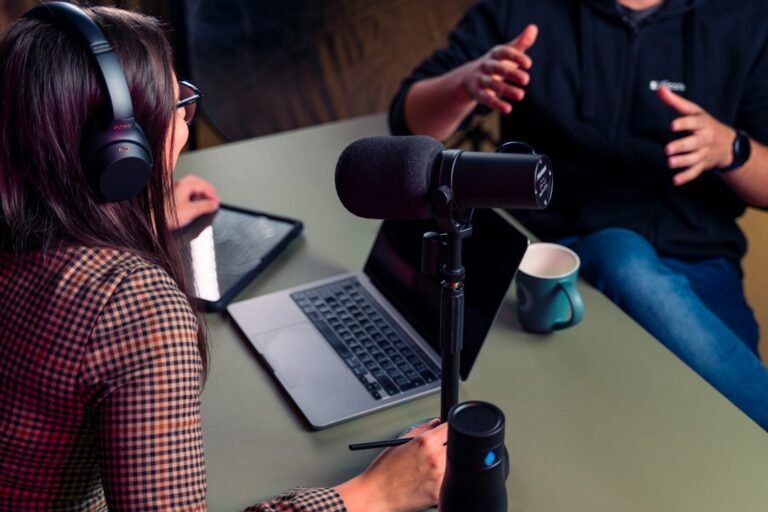
Interviewing is a conversation with a purpose, not a list of questions delivered mechanically. Research your guest’s publicly available work, prepare an opening question that invites explanation, and identify two or three subjects worth exploring. Ask one question at a time. Listen to the answer before deciding what to ask next. When someone gives a vague response, request an example or clarification rather than repeating the original question more loudly.
Respect boundaries. A guest may decline a personal question, and the interviewer should understand when pressing further is inappropriate. For factual disputes, a fair follow-up can be direct without becoming hostile. Practice with classmates, coworkers, community organizers, or people who have agreed to participate. Obtain consent to record and share their contributions. Keep a copy of any permissions needed for portfolio use, especially when filming minors or inside private premises.
Learn the production process
A presenter works within a team. Producers plan segments, editors assemble footage, camera operators manage images, audio staff handle sound, and directors coordinate timing. Even when one person performs several of these roles, understanding the workflow helps you contribute effectively. Learn what a rundown is, how a segment is timed, and why a producer might shorten an introduction at the last minute. Practice giving a concise handoff to a prerecorded clip and returning to the story afterward.
Try a simple five-minute mock program with an opening, two short stories, one interview, and a closing. Assign time limits to each section and use a stopwatch. Notice how long transitions actually take. If a guest talks for an extra minute, decide which later section can be shortened without losing essential information. This exercise teaches editorial judgment and flexibility, not just performance.
Choose training that fits your budget
Formal study can be helpful, but it is not the only possible route. Relevant programs include journalism, broadcast production, communications, theater, and media studies. Evaluate courses by what students actually produce, who teaches them, whether they provide equipment access, and whether they connect learners with legitimate placements. A high tuition fee or a promise of industry contacts does not guarantee employment.
Low-cost practice can be just as valuable at the beginning. Community media organizations, campus stations, local theater, public-speaking groups, and student newsrooms may offer chances to learn. Check their participation rules and whether the work can be included in your portfolio. Workshops can address specific weaknesses, such as interviewing, voice technique, or reading from a teleprompter. Choose a course because it develops an observable skill, not because its advertising implies that fame will follow.
Create a showreel that proves your abilities
A showreel is a short collection of presenting clips. Its purpose is to help an editor or hiring manager quickly understand what you can do. Open with a strong example relevant to the job you want. Include clear sound, stable footage, and enough context for viewers to understand the segment. A reel of unrelated visual effects may look impressive while revealing little about your presenting skills.
Consider including a brief introduction to camera, a real interview excerpt used with permission, a live-style transition, and a short explanation of a complex topic. Label practice footage honestly; never suggest a mock newscast was broadcast by a station when it was not. Avoid using copyrighted television footage without permission. Save a longer version of each segment so employers can assess your performance beyond a few carefully edited seconds.
Make a simple professional portfolio
A portfolio page can include your name, the types of roles you seek, your showreel, a short biography, selected full-length clips, and a professional contact method. Keep the layout easy to navigate on a phone. If you have relevant language skills, interviewing experience, event-hosting work, or editing knowledge, describe them accurately. You do not need to invent broadcast credits to appear credible.
Include captions when practical so viewers can follow the material without sound. Review each link before submitting an application. Broken video links, private files that require permission, or missing audio can prevent an employer from evaluating otherwise strong work. If your portfolio includes someone else’s face or voice, confirm that you have the appropriate consent for public display.
Find realistic first opportunities
Not every presenter begins on a national television channel. Local news organizations, community stations, digital publishers, sports clubs, universities, events teams, and production companies may offer entry points. Some positions are titled reporter, video journalist, multimedia producer, host, presenter, production assistant, or content creator. Read the actual responsibilities rather than assuming a job title means on-camera work.
Search legitimate employer career pages and established job boards. Tailor each application to the program format. For a local news role, highlight accurate reporting and interviewing. For a shopping channel, demonstrate clear explanations, honest product demonstrations, and comfort responding to questions. For sports, show subject knowledge and the ability to communicate quickly. Avoid paying someone who guarantees an audition or demands large upfront fees for a supposed job placement.
Prepare for auditions and screen tests
An audition may ask you to read a script, introduce a guest, react to a change in instructions, or improvise a short segment. Read the brief carefully and ask about timing, wardrobe, location, and whether the recording may be reused. Rehearse the material enough to understand it, but remain flexible. A producer may want a different pace or tone, and responding constructively is part of the assessment.
Bring appropriate identification and any materials requested by the employer. Arrive early enough to test audio and become familiar with the room. If a mistake occurs, correct it without apologizing repeatedly. When asked to discuss an unfamiliar subject, explain what you know and do not pretend expertise. Good preparation includes checking the employer’s official website and understanding the intended audience.
Understand pay and working conditions
Presenter compensation varies with market, employer, contract type, experience, program schedule, and duties. A full-time newsroom employee may have a salary and benefits, while a freelance event or digital host may be paid by assignment. Some jobs combine presenting with reporting, research, editing, or social-media production. An advertised figure should be read alongside the hours, location, travel, and responsibilities required.
Do not rely on celebrity salary websites as proof of what an entry-level presenter will earn. If you receive an offer, ask whether preparation and travel time are compensated, who owns the recorded material, and what happens if a segment is canceled. Understand exclusivity clauses and any restrictions on outside work. For freelance roles, request clear written terms before committing to a project.
Develop a sustainable improvement routine
A practical weekly plan is more useful than recording random clips whenever you feel inspired. On one day, research and write a two-minute explanation. On another, film it and review clarity. Practice one interview each week with a willing participant. Once a month, edit your strongest clips into a refreshed reel. Track a few measurable improvements, such as fewer factual corrections, clearer audio, stronger follow-up questions, or more consistent timing.
Ask for feedback from people who understand the intended audience. A friend may say that you look confident, but a producer might notice that the story’s key fact arrives too late. Request specific comments: Was the opening understandable? Did the interview produce useful answers? Was the segment too long? Did any claim need verification? Use criticism to revise your next recording instead of defending every choice.
Common mistakes to avoid
One mistake is copying the voice and mannerisms of a famous presenter. Another is focusing entirely on appearance while ignoring research, listening, and accuracy. A third is applying only to highly competitive national roles without building smaller examples of professional work. Some applicants also upload reels with music louder than their speech, cluttered graphics, or a long introduction before the best clip appears.
Be cautious about misleading online advice. A paid course is not an employment contract, a large social-media following does not automatically establish broadcast skill, and a single viral clip does not guarantee a long career. Treat presenting as a craft that improves through repeated work and collaboration. Maintain a professional online presence, but do not feel obliged to share private information to prove that you are interesting on camera.
A practical 30-day starter plan
During the first week, choose a presenting format and study several examples, paying attention to how the presenters open, transition, and close. Write three short scripts and record them. In the second week, practice an interview and a short live-style introduction. Review sound quality, factual accuracy, and timing. In the third week, create a five-minute mock program, ask for detailed feedback, and revise the weakest segment. In the fourth week, assemble a concise showreel, publish a simple portfolio, and identify a manageable set of legitimate opportunities.
The purpose of this plan is to produce evidence of skill, not to secure a job within 30 days. Some people will need longer to improve speech clarity, acquire equipment, or find collaborators. Adapt the schedule to your responsibilities and budget. Consistent, thoughtful practice is more valuable than an arbitrary deadline.
Frequently asked questions
Do you need a degree to become a TV presenter?
Not universally. Some employers prefer journalism or communications qualifications, especially for reporting-intensive roles. Others focus on practical experience, subject knowledge, and the quality of a screen test. Check individual job descriptions rather than assuming all employers use the same criteria.
Can you become a presenter without previous television experience?
Yes, although you still need convincing examples of relevant skills. Community interviews, digital video projects, student media, live events, and independently produced demonstrations can help build a portfolio. Be transparent about which clips are practice and which were commissioned or broadcast.
Do you need an expensive camera or studio?
No for early practice. A phone with stable framing and clear sound is enough to develop delivery and interviewing skills. Better equipment may become important for professional production, but it cannot replace accurate research, a clear script, and attentive listening.
How long does it take to get a presenting job?
There is no reliable universal timeline. Opportunities depend on your skills, location, available roles, and the strength of your applications. Building a portfolio and applying consistently improves your readiness but does not guarantee employment by a particular date.
Is a large social-media following required?
Usually not for traditional entry-level broadcast roles, though some digital and entertainment employers consider audience reach. A following may demonstrate engagement, but it does not substitute for editorial judgment, accurate communication, or teamwork.
Final takeaway
To become a TV presenter, select a realistic format, learn to write and speak clearly, practice interviewing, understand production, and build a portfolio that demonstrates your work. Seek legitimate smaller opportunities while improving your reel. Focus on reliability and audience service rather than instant recognition. Presenting is a professional skill set, and the strongest first step is to make one useful, well-researched segment that another person can actually watch and evaluate.
Useful Career Resources
For an overview of the role and training routes, consult the UK National Careers Service TV presenter profile. For interview ethics and responsible journalism, review the Society of Professional Journalists Code of Ethics. Requirements differ by market and employer.
 How to Interview a Celebrity: Questions, Preparation, and Ethics
 What Is a Celebrity Crush? Meaning, Feelings, and Healthy Boundaries
 What Is a Celebrity Hall Pass? Meaning and Relationship Boundaries